Your agent shipped it.Who tells you what changed?
A competitor cuts its price. OpenAI retires the model your app calls. Forge watches your market every week and tells you, with a source under every line.
- no card
- 1 product free
- a brief a week
- $29 a month after, flat
- no credits
- 1Open this week’s brief
- 2Open the page a line came from
- 3Label it
Free · no account
The market, open to anyone.
Every sector Forge reads, as a map you can search. A dashed cell is a complaint users raised about two or more companies there that none of them answers. No card, and no model runs when you open it.
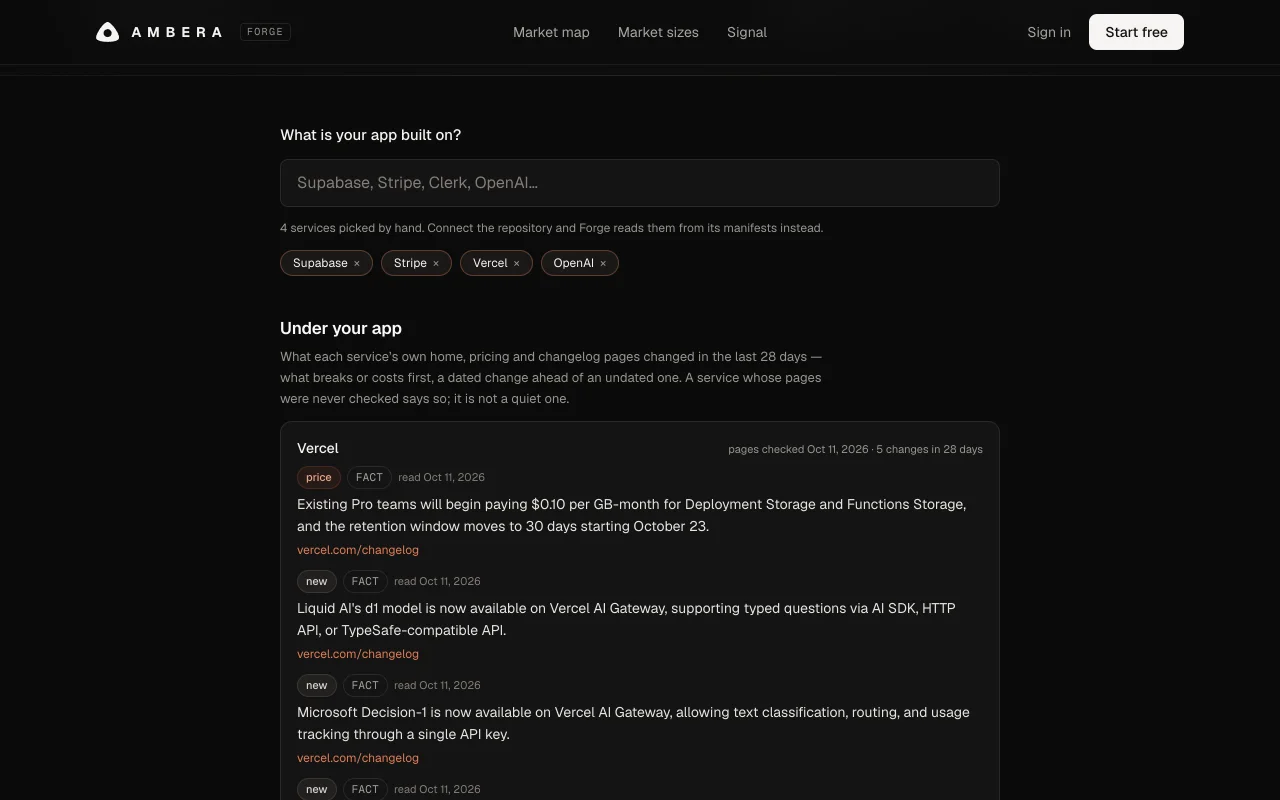
Already built it? Name what it runs on and read what changed under it this week. What changes under your app →
Just launched? Fourteen Show HN launches a week, each with three sourced lines about its market. The launch radar →
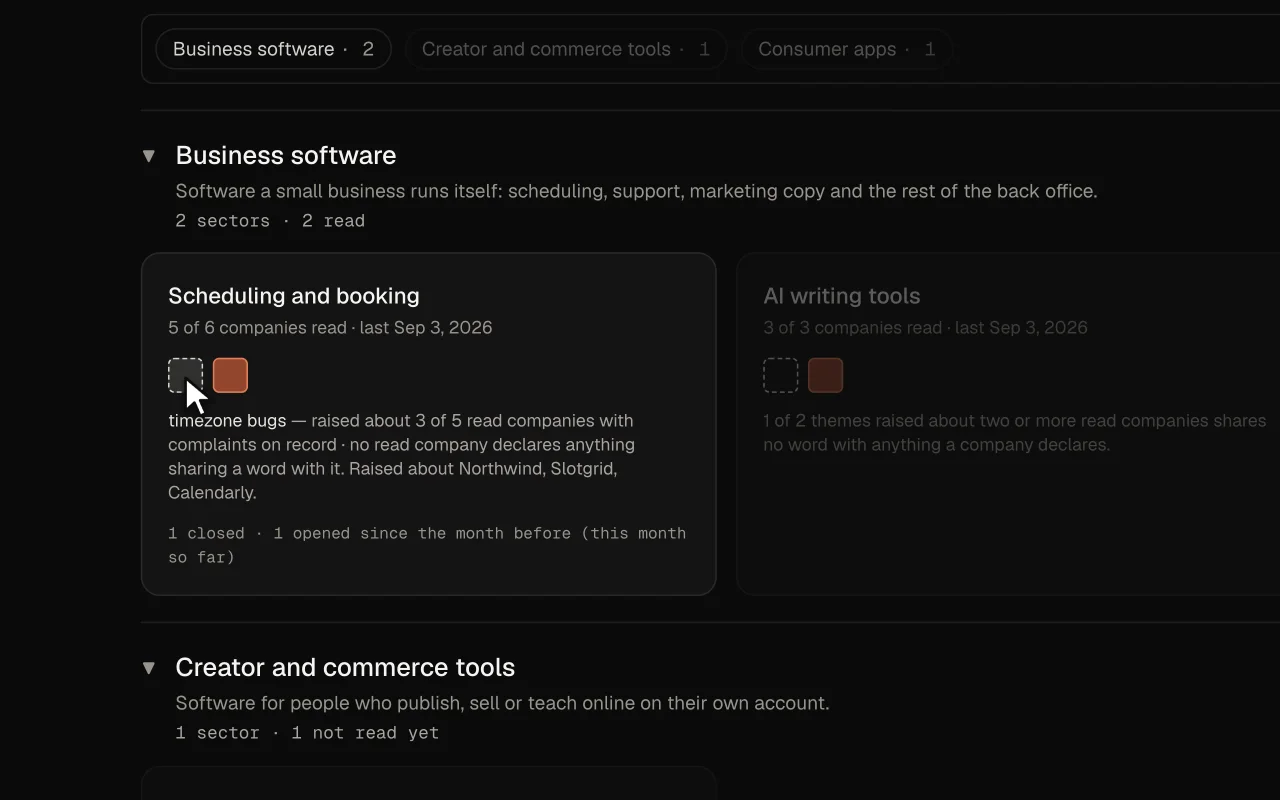
The shipped map over fixture companies, every count computed by the shipped math.
What a chat cannot do
It answers once, from nothing, and forgets.
Ask ChatGPT or Claude about your market and you get one answer, read that minute. Forge runs again every Monday without you, keeps last week beside this one, and knows what your app is built on.
01 · Every day
The day Stripe, Supabase or OpenAI changes something your app calls.
Forge reads which services your app rests on and checks their pricing and changelog pages every day, with no model. A stated change reaches you the same day, with the files in your app it touches. On every plan, including Free.
02 · Every week
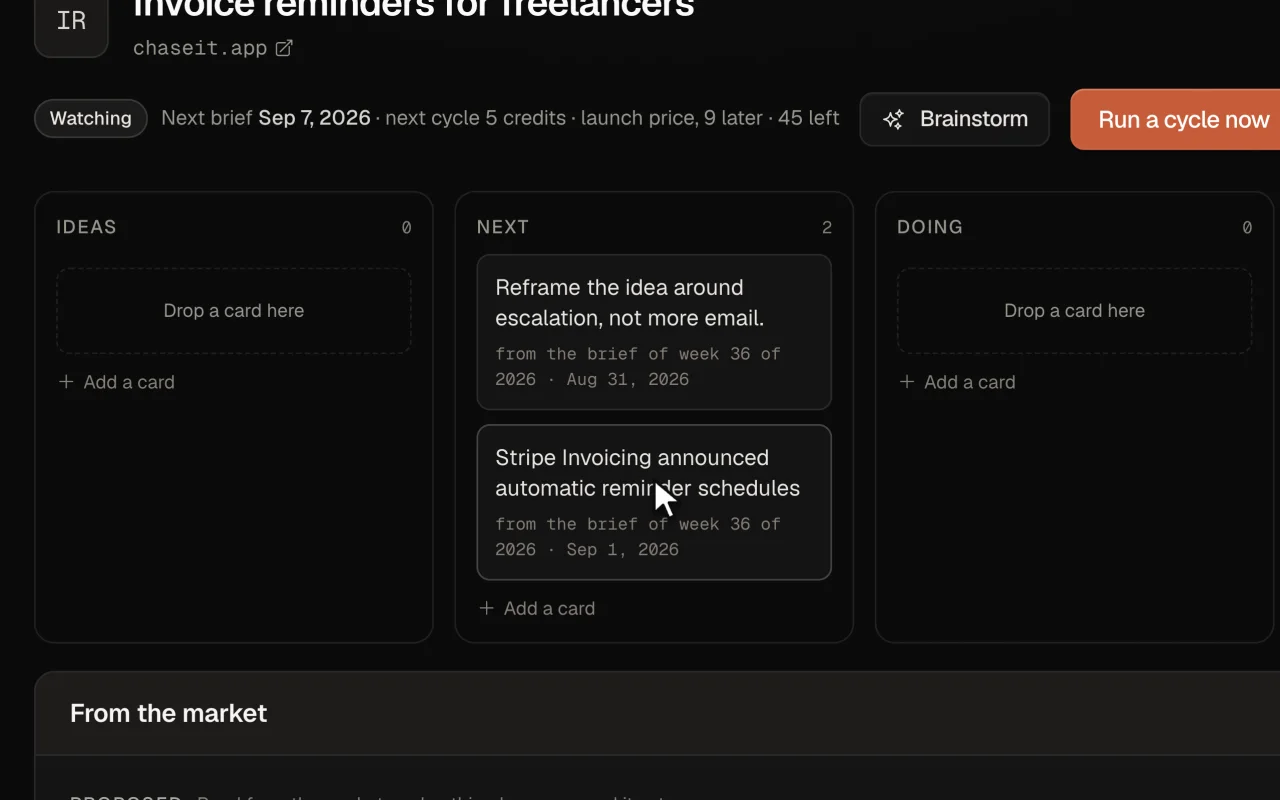
What to build next, proposed from your market.
A feature two watched companies declare and your product does not carry becomes a card with their names on it. File a line from the brief, type your own, or argue with the brainstorm. Nothing here is a task.
03 · Every cycle
A market-fit number that falls when the market moves, and says why.
Once three companies are watched and two briefs exist: the market half from the web, your half from your own description and your marks. Every component shows the rows it counts; until then, the date it arrives.
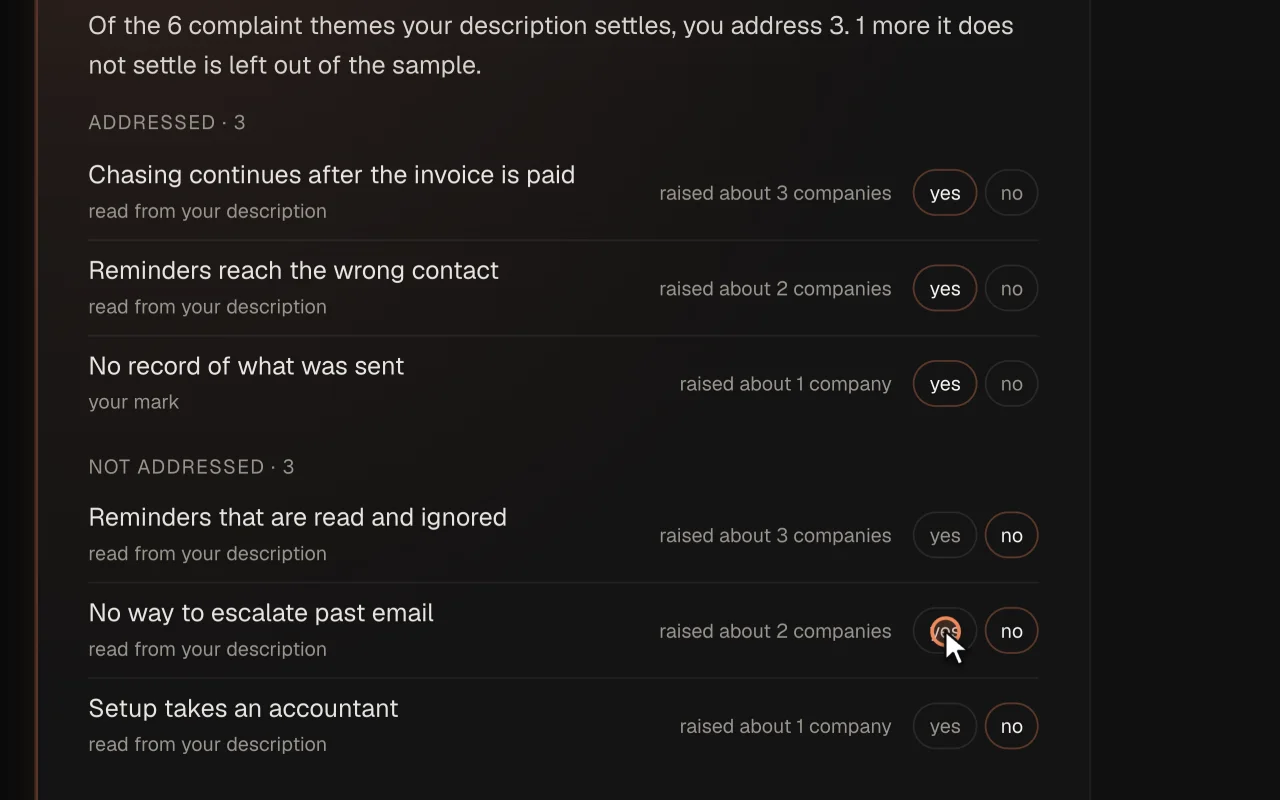
Screens of the product’s own design harness over fixture companies, every count computed by the shipped math. The first is the public page as it stood on 11 October 2026.
Pricing
Free to start. $29 a month, flat. No credits.
One price, one limit: how many products Forge watches for you. Nothing inside is metered. Free includes 1 product and its first 2 briefs.
Forge Free
$0no card
1 product · 2 briefs · the alerts keep running
Get the answer before you pay for anything.
- —1 product, up to 12 companies watched each
- —2 briefs per product — enough for the market-fit number
- —Same-day alerts when a service your app rests on breaks, retires or reprices something
- —The market map, the market sizes and what changes under your app — public, read once for everyone
Forge Solo
$29/ month, flat
3 products · 12 companies watched each · nothing metered
The co-founder your agent cannot be.
- —3 products, up to 12 companies watched each
- —A brief every week, or every two or four — your choice
- —Same-day alerts when a service your app rests on breaks, retires or reprices something
- —A board of what to build next, proposed from what your market declares
- —A brainstorm that argues from the same reading — included
- —The MCP connector, so your coding agent starts from the brief
- —A read you start by hand, once a day per product, on top of the schedule
Building with a team? Team is $69 a month flat for the whole workspace — no seats, 10 products shared, nothing metered — for the first 100 workspaces, $99 after. Premium adds the org layer: talk to us.
Why there are no credits
A meter on a weekly read switches the read off. We tried it.
Nothing runs out mid-week.
The market-fit number needs 2 briefs. A balance that ends after the first pauses your product the week before the number arrives — where every product on the old meter ended. A plan's one limit, how many products it watches, cannot be reached by waiting.
What you pay for never stops.
The weekly brief, the daily check of the services under your app and the alerts run on their own schedule. A meter makes you switch a read off to save money, and a read switched off is a gap in the record.
No arithmetic before a question.
The brief, the board, the brainstorm, the alerts and the MCP connector are in the price. No top-up, no balance in the sidebar. One number on the invoice, and it is the one on this page.
Before you sign in
The questions builders ask first.
Where the honest answer is “it cannot see that”, the answer says so.
- Why not just ask ChatGPT or Claude about my market?
- Ask it and you get one answer, from nothing, gone when the tab closes. Forge runs again every week without you, keeps a dated record — every price that moves, every complaint counted across the companies it was raised about — and checks the services under your app every day. The MCP connector hands your agent that record, so the chat starts from it.
- Can I validate the idea before I build anything?
- Yes. Describe it, confirm who to watch, and a brief arrives every week with each claim tagged and sourced. The market-fit number arrives once three companies are watched and 2 briefs exist — Free includes exactly those — and until then the page says the date, never a number invented from silence.
- What does free include, and why are there no credits?
- 1 product, no card: its first 2 briefs, enough for the market-fit number, and same-day alerts for the services your app rests on, which keep running after. No credits, because a balance ran out at the worst moment: every product on the old meter ended paused the week before its number. Solo is $29 a month flat for 3 products, 12 companies watched each.
- Will it tell me when Stripe, Supabase or OpenAI changes something under my app?
- Yes. Forge reads which services your app rests on from its manifests and checks their own homepage, pricing and changelog every day, without a model. A stated change — a price, a retired model, a breaking change — reaches you the same day with the files it touches. “Not checked yet” is never shown as “no change”. On every plan.
- Can I see the market without an account?
- Yes. The market map at forge.ambera.app/sectors is public: every sector Forge reads, with the complaints users raised about two or more companies there that none of them answers — counted, dated, withheld when too few companies were read. An account adds your own product against it, every week.
- What happens to my code and my description?
- Your description is kept verbatim and shown as yours; it is the one input Forge does not measure. Forge does not read your code to say what your product is: from a connected repository it reads the manifests, for the services your app rests on, and the README once, as a draft you can throw away.
Start free
Find out what changed in your market — this week, and every week after.
Google, GitHub or an email. 1 product free, no card, no credits: describe the idea, confirm who to watch, and the first of 2 briefs runs.